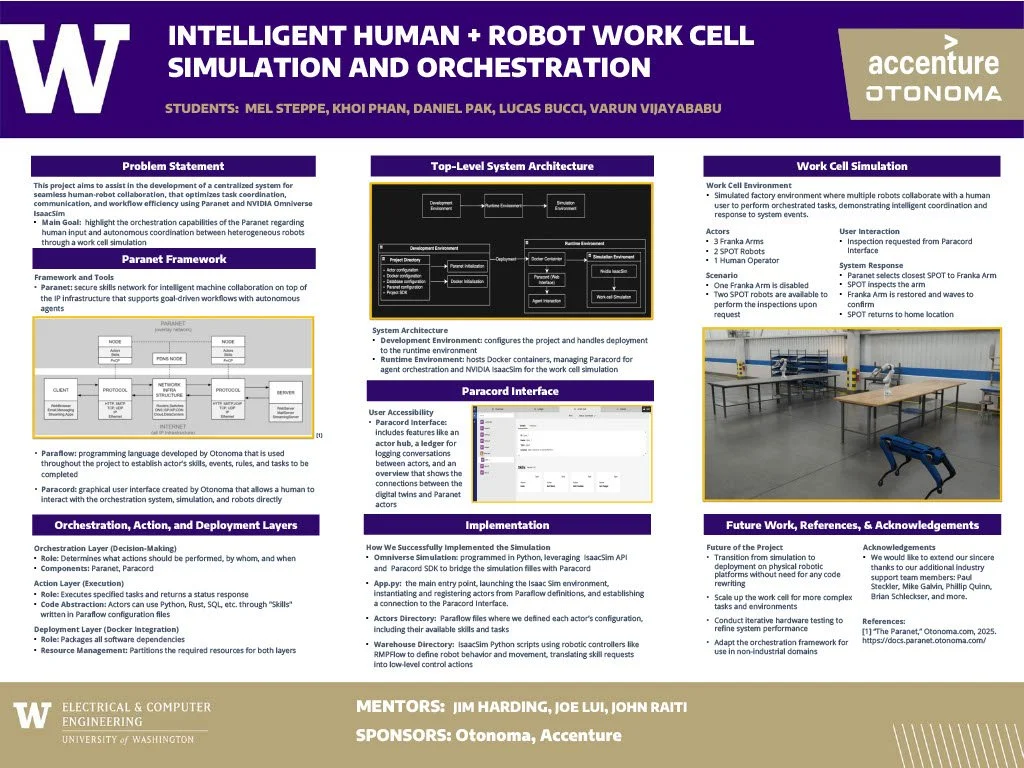
In the spring of 2025 Otonoma partnered with Accenture and a talented group of students from the University of Washington’s Electrical & Computer Engineering (UW ECE) department to test the Paranet’s orchestration capabilities using an innovative work cell simulation.
The Challenge:
Modern industrial environments often struggle with "silos" where humans and various robotic systems operate in isolation. This fragmentation leads to downtime and inefficiency. Our goal was to create a centralized system for seamless collaboration, optimizing task coordination and workflow efficiency.
The Solution: Paranet + NVIDIA Omniverse
Leveraging the Paranet framework—our secure skills network for intelligent machine collaboration—and NVIDIA Omniverse IsaacSim, the team developed an intelligent human-robot work cell.
Paranet acted as the "brain," providing the secure infrastructure for goal-driven workflows and autonomous coordination between heterogeneous actors.
IsaacSim provided the high-fidelity simulation environment where robots, powered by the Paracord SDK, could translate high-level skill requests into precise low-level movements.
Why It Matters:
This project demonstrates how we can bridge the gap between Information Technology (IT) and Operational Technology (OT). Using the Paranet, students showed that it's possible to manage complex, rapidly evolving environments without rigid, centralized designs.
A huge thank you to the UW students—Mel Steppe, Khoi Phan, Daniel Pak, Lucas Bucci, and Varun Vijayababu—and our partners at Accenture for helping us prove that the future of work is not just automated, but truly autonomous.
